ENGLISH HERITAGE REVIEW OF CHURCHES IN DIOCESE
2005 (EXTRACT)
St Mary Magdalen, Brighton
55 Upper North Street, Brighton, East Sussex BN1 3FH
HISTORIC IMPORTANCE OF CHURCH
ARCHITECT(S) & DATE(S): Gilbert Robert Blount 1861-2
LISTED STATUS: Grade 2
CONSERVATION AREA: Yes
LIST DESCRIPTION:
Roman Catholic church. 1861-2. By Gilbert Robert Blount. Red brick set in English bond with dressings of stone, black brick and blue-glazed brick, spire of stone. 2-bay chancel, nave of 5 bays with north and south aisles, north tower and north-east vestry. EXTERIOR: all openings have stone hoodmoulds with voussoirs above of black and blue-glazed brick, linked to springing bands of the same materials. Window tracery a mixture of geometrical and flamboyant. East window in the form of a spherical triangle with flamboyant tracery. South-east chapel under a pitched roof with angle buttresses, pointed-arched east window--.with quatrefoil over 3 cusped lancets; 2 south windows with stilted arches and quasi-quatrefoil over 2 cusped lancets. South
aisle of 5 bays, the windows pointed-arched with a quatrefoil over 2 cusped lancets, buttresses between the second, third and 4 bays from the west and between the aisle and the south chapel; clerestory of 10 stilted segmental-pointed arches with 2 cusped lancets each. Entrance in western bay of south aisle, shoulder-arched under a pointed arch with multi-moulded arch dying into deep chamfered jambs. The north side is treated in the same way, except that the tower abuts the second bay of the north aisle: tower of 3 stages with angle buttresses; pointed-arched entrance flanked by engaged columns with foliage capitals supporting 2 orders of moulded arches; gabled buttresses to either side with gabled niches for statues; 2 lancets to second stage; paired cusped lancets under a stilted pointed arch to belfry; corbel table; broach spire with 2-light lucarnes: Single-storey vestry partly under a pitched roof with two 3-light cusped windows under a segmental arch flush with the wall, lower parapeted part to west with pointed-arched entrance; low wall to Upper North Street of brick with stone chamfered coping; piers and railings survive west of the tower, but not to the east. (Builder: 3 August 1861, 8 March-1862).
Clergy House Grade II
No 55 Clergy House to Church of St Mary Magdalene and attached wall II Clergy house. c1890. Red brick set in English bond with stone dressings, roof of asbestos slate. 3 storeys over basement, 3-window ranges to Upper North Street and to Spring Street. The building reads as 2 wings, with a hipped range in Upper North Street and a gabled range in Spring Street. Tudor-arched entrance in Upper North Street, with stone dressings, 3-light overlight and hoodmould; Tudor-arched entrance in Spring Street with brick dressings; chamfered corner to ground floor; scattered fenestration, the windows of one and 2 lights, round-arched, Tudor-arched, and segmental-arched. External stack to Spring Street now lacking its full height; glazing renewed throughout, 1992.
INTERIOR: not inspected. Low wall in Spring Street coped with ridge
tiles.
School Grade II (now the parish hall) School buildings. C1865. Red brick set in English bond, dressings of stone and black brick, roof of slate. EXTERIOR: 2 storeys over basement; one-window range to north, facing into Upper North Street, 3-window range to east. Segmental-arched entrance in basement of east front with stone dressings and voussoirs of black and red brick, and canopied niche over. On the ground floor, 2-windows to Upper North Street, 3 to east, all flat-arched, of 2 lights and one transom, the mullions and transoms being of stone on Upper North Street but wood on east front, and all with relieving arches of black and red brick over. Storey band of black brick. On the first floor, the east front has 3 pairs of segmental-arched windows with one transom, each pair under a full dormer; and the front to Upper North Street has one 4-light window with cusped tracery and one transom, and voussoirs of black and red brick; a band of black brick in the gable. Staircase wing to south-east under a hipped roof.
The south front is detailed as for the north front but is stuccoed; single-storey extension to south-west. INTERIOR: not inspected..
POSSIBLE AMENDMENTS/ADDITIONS TO LIST DESCRIPTION:
The church was built at the instigation of Father George Oldham, to serve what was then the West Brighton Missionary District. The sanctuary and side chapels opened in July 1861; the nave was opened in February 1862. The Builder in 1862 reported ‘The nave…has been opened. The chancel was finished in July last. The edifice is in the Modern Florid Gothic style…’ The
nave was extended by 33 feet and the spire added and the church formally opened on 16 th August 1864. The list description does not mention the interior. The walls are plastered with stone dressings. The corbels supporting the roof trusses for a band of angels. The arcade columns have big stiff-leaf capitals, whilst the sanctuary and side chapels have richly carved and painted altars and reredos. These contain scenes from scripture, interspersed with statues in canopied niches, with columns of coloured marbles. Also stone and marble font and ambo. The quality of the carving is high and it appears that Blount intended the richness to be achieved through the quality of the carving and the contrast between the stone and coloured marbles rather than through the use of any applied colour. By 1924 much of the stonework had been lime washed, perhaps in response to staining. The church was redecorated in the
1950s, 1960s and 1970s and this has eroded the quality of the interior. Good stained glass. The 1913 organ was replaced in 1962. To celebrate the centenary, in 1962, statues of St Joseph and St George by Joseph Cribb of Ditchling, were inserted into the niches over the main door. A major re-ordering and redecoration scheme was implemented in 1973-4, the work carried out by Messrs. Jimmy and Kevin Frame. The roof timbers were painted for the first time and gold stencil-work applied. The altar rails were removed in the early 1990s. Gilbert Blount (1818-1876) is one of the lesser-known 19 th century Roman Catholic architects, perhaps because he was not very prolific. He began his professional training as a civil engineer with I K Brunel and worked on the construction of the Thames tunnel., nearly loosing his life in one of the floods that occurred during construction. He worked for a time with Sydney Smirke before setting up on his own and specialising in work for the Roman Catholic community. Blount’s churches are always well crafted but sometimes lack personality, being faithful essays in C13 gothic. In the
Arundel & Brighton diocese Blount also designed St Anthony & St George’s church in Duncton (1869).
The Builder 3 rd August 1861, p534; The Builder 8 th March 1862 p172; The Builder 25 th June 1864, p478; The Builder 3 rd September 1864, p657.
STATEMENT OF IMPORTANCE A stately and lavish town church, of considerable townscape significance grouped with school and presbytery.
Monday, May 14, 2007

Tuesday, July 25, 2006
The Archbishop who wasn't a gentleman
There is an intriguing story told by several older priests about one of my predecessors who having been informed that Bishop, later Archbishop, Amigo was to visit St Mary Magdalen's wrote, "My Lord, I will offer you every facility that my Church may afford on your forthcoming visitation, however as for admittance to my house that can never be as you are not a gentleman". More elaborate versions of the story have the parish priest sending Amigo a "half crown" postal order for lunch. There is, possible not surprisingly, no account in the Southwark or Arundel and Brighton archives.
Does anyone have any information on this story? Who was the parish priest?
Many clergy in the diocese of Southwark disliked their bishop intensely, he could be pretty tough, he hated the Archbishop of Westminster (see the story about Mgr Wallace on the Main Page). There is one story about him which I rather like, he was stopped in the street by a rather high church Anglican clergyman, who said, "My Lord, I am a Catholic, I pray for you everyday at Mass, I believe you are my rightful bishop. In my church we obey all your rulings and read your pastoral letters ...etc. etc." To which the Archbishop said, "Mmm, in that case I suspend you, good day sir".
Does anyone have any information on this story? Who was the parish priest?
Many clergy in the diocese of Southwark disliked their bishop intensely, he could be pretty tough, he hated the Archbishop of Westminster (see the story about Mgr Wallace on the Main Page). There is one story about him which I rather like, he was stopped in the street by a rather high church Anglican clergyman, who said, "My Lord, I am a Catholic, I pray for you everyday at Mass, I believe you are my rightful bishop. In my church we obey all your rulings and read your pastoral letters ...etc. etc." To which the Archbishop said, "Mmm, in that case I suspend you, good day sir".
Monday, July 24, 2006
From the archives circa 1910

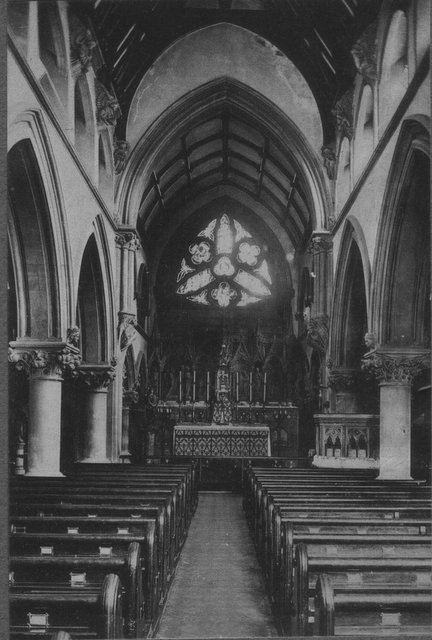


These are the first photographs we have of the Church, notice how already the stonework is seriously smoke blackened, Our conservationist says that various colour schemes were tried until in the 1980s the entire Church was painted spray painted battleship grey, with gilt, copper and bronze spray painted highlights.
Monsignor Moore's Morse

Someone asked for a better picture of the Morse which St Mary Magdalen was wearing on her feastday.
It is presumed that it belonged to Mgr Moore, it is rather crude but is covered with irregular polished and facetted semi-precious stones.
Gilbert Blount

Blount was an English Catholic architect active from about 1840-70. He received his earliest training as a civil engineer under Brunel (c.1825-28) for whom he worked as a superintendent of the Thames Tunnel works. After a period in the office of Syndney Smirke, Blount was appointed as architect to Cardinal Wiseman, the Catholic Archbishop of Westminster.
Blount's mature work coincided with the resurgence of Catholic church building in England. His activity as an architect was largely in service of the need for new churches and related ecclesiastical institutions.
About the CollectionHoldings include studies for eleven churches (1844-74), two tabernacles, reredos, two pulpits, a stained glass window, twelve high altars. Among the churches are St. Ambrose Church, Kidderminster, Worchestershire, 1858; St. Edward, Clifford, Yorkshire, c.1844-45; St. Mary, Husband's Bosworth, Leicestershire, 1873-74; St. Mary Magdalene, Brighton, Sussex, 1861-62; St. Peter, Gloucester, 1859-60, 1867-88; Our Lady and St. Catherine of Siena Church, London, 1869-70.
Tuesday, July 18, 2006


Subscribe to:
Comments (Atom)